
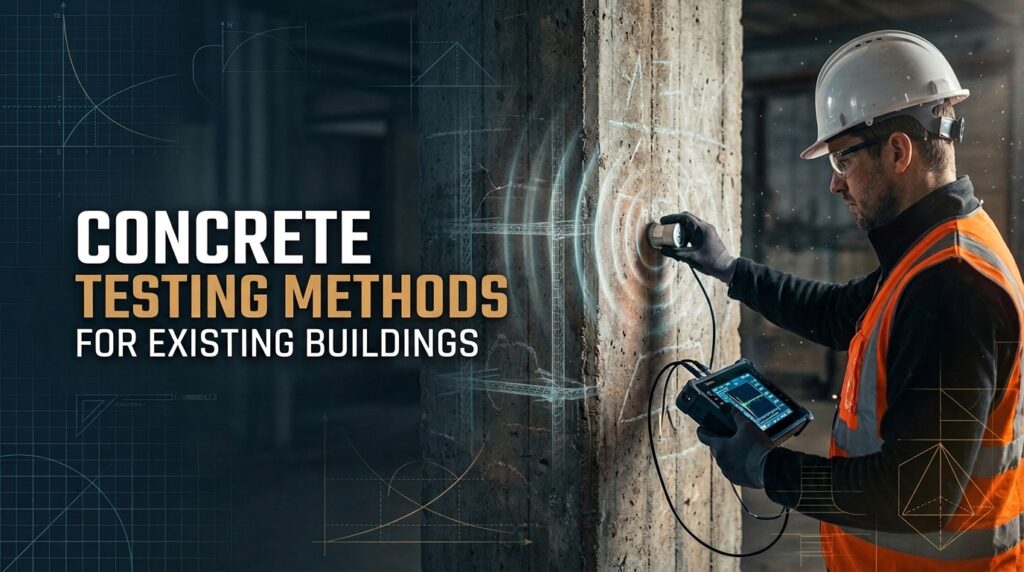
concrete testing methods for existing buildings uses non-destructive tests (NDT) such as the rebound hammer, ultrasonic pulse velocity, cover meter, half-cell potential and ground penetrating radar, combined with partially destructive tests such as core cutting, carbonation depth and chloride content. Together they measure the strength, quality, durability and reinforcement condition of the concrete without demolishing the structure. Engineers choose the mix of tests based on the age of the building, the visible defects and the decision the owner needs to make.
This guide explains each method, what it measures, the standard it follows and when it is the right choice for villas, residential towers and commercial buildings in Abu Dhabi and Dubai.
Why Do Existing Buildings Need Concrete Testing?
Concrete in the UAE works in a harsh environment. High temperatures, humidity near the coast, salty groundwater and airborne chlorides all speed up deterioration. Testing gives owners and engineers hard data instead of guesses. The most common reasons for testing an existing building are:
- Visible cracks, spalling, rust stains or exposed reinforcement
- Planned additions such as an extra floor, a roof structure or new heavy equipment
- Change of use, for example converting a villa into offices or a nursery
- Buying or selling a property and needing a clear picture of its structural condition
- Building Condition Certificate (BCC/CBC) and periodic condition assessment requirements
- Fire damage, water leakage or flooding
- Missing original drawings or doubts about the as-built concrete grade

Book a consultation with our engineering team
Non-Destructive Testing (NDT) vs Partially Destructive Testing
Concrete tests fall into two groups. Non-destructive tests leave the structure intact and can cover large areas quickly. Partially destructive tests remove a small sample or make a small opening, which is then repaired. Partially destructive tests give the most reliable values, so a good testing program uses NDT to survey the whole building and a limited number of cores to calibrate the results.
| Test | Type | What it measures | Main standard |
|---|---|---|---|
| Rebound hammer (Schmidt hammer) | Non-destructive | Surface hardness, estimated strength and uniformity | ASTM C805, BS EN 12504-2 |
| Ultrasonic pulse velocity (UPV) | Non-destructive | Internal quality, voids, honeycombing and cracks | ASTM C597, BS EN 12504-4 |
| Cover meter (rebar scanning) | Non-destructive | Concrete cover depth, bar location and approximate size | BS 1881-204 |
| Half-cell potential | Non-destructive | Probability of reinforcement corrosion | ASTM C876 |
| Ground penetrating radar (GPR) | Non-destructive | Rebar layout, slab thickness, embedded services and voids | ASTM D6087 (bridge decks), manufacturer methods |
| Core cutting and compression test | Partially destructive | Actual in-situ compressive strength | ASTM C42, BS EN 12504-1, BS EN 13791 |
| Carbonation depth | Partially destructive | Depth of carbonated concrete compared to cover | BS EN 14630 |
| Chloride content | Partially destructive | Chloride level that can trigger corrosion | BS EN 14629, ASTM C1152, ASTM C1218 |
| Load test | In-situ structural test | Actual behaviour of a slab or beam under load | ACI 437 |
1. Rebound Hammer Test
The rebound hammer is the fastest and cheapest concrete test. A spring-loaded mass strikes the concrete surface, and the rebound number shows how hard the surface is. A higher rebound number means harder, usually stronger concrete.
The rebound hammer is excellent for checking uniformity across many columns, beams and slabs in a short time. It is not accurate enough on its own to confirm compressive strength, because carbonation, surface moisture, plaster and the direction of the impact all affect the reading. For a reliable strength estimate, engineers correlate rebound results with a small number of cores taken from the same structure.
2. Ultrasonic Pulse Velocity (UPV) Test
The UPV test sends an ultrasonic pulse through the concrete between two transducers and measures how fast it travels. Dense, well-compacted concrete transmits the pulse quickly, while cracks, voids and honeycombing slow it down.
A commonly used guide for interpreting results is:
| Pulse velocity (km/s) | Concrete quality |
|---|---|
| Above 4.5 | Excellent |
| 3.5 to 4.5 | Good |
| 3.0 to 3.5 | Medium |
| Below 3.0 | Doubtful |
Combining UPV with the rebound hammer (the SonReb method) gives a better strength estimate than either test alone, because moisture and surface hardness affect the two readings in opposite ways.
3. Cover Meter Test
A cover meter uses an electromagnetic field to locate steel bars and measure the depth of concrete covering them. Concrete cover is the first line of defence against corrosion. If the cover is thinner than the design requires, carbonation and chlorides reach the steel much sooner.
Cover meter scanning is also used before core cutting or drilling, so the core avoids cutting through the main reinforcement.
4. Half-Cell Potential Test
The half-cell potential test measures the electrical potential of the reinforcing steel against a reference electrode placed on the concrete surface. The result is plotted as a corrosion map of the element. Under ASTM C876, using a copper/copper sulfate electrode:
- More positive than −200 mV: less than 10% probability of active corrosion
- Between −200 mV and −350 mV: uncertain corrosion activity
- More negative than −350 mV: more than 90% probability of active corrosion
This test is especially valuable in coastal areas of Abu Dhabi and Dubai, where chloride-induced corrosion is the main cause of concrete deterioration.
Book a consultation with our engineering team
5. Ground Penetrating Radar (GPR)
GPR sends radar waves into the concrete and records reflections from steel bars, ducts, voids and the back face of the slab. It produces a clear image of the reinforcement layout and slab thickness, which is very useful when original drawings are missing or when new openings, anchors or post-tensioned slabs are involved.
6. Core Cutting and Compressive Strength Test
Core cutting is the most reliable way to know the real compressive strength of concrete in an existing building. A diamond core drill removes a cylindrical sample, usually 100 mm in diameter, which is then trimmed, capped and crushed in a laboratory. The hole is filled immediately with a non-shrink repair mortar.
Key points for a valid core test:
- The core diameter should be at least three times the maximum aggregate size
- Locations are scanned first to avoid main reinforcement
- The length to diameter ratio is recorded and corrected according to the standard
- Results are assessed statistically under BS EN 13791 or ACI 318 criteria, not judged by a single core
7. Carbonation Depth Test
Carbon dioxide from the air slowly reacts with concrete and lowers its alkalinity. Once the carbonated zone reaches the steel, the protective layer around the bars breaks down and corrosion can start. The test is simple: a phenolphthalein indicator is sprayed on a freshly broken surface or core. Uncarbonated concrete turns pink, and carbonated concrete stays colourless. Comparing carbonation depth with the measured cover shows how close the steel is to losing its protection.
8. Chloride Content Test
Chlorides come from contaminated aggregates, mixing water, groundwater and sea air. Dust samples are drilled at several depths and analysed in a laboratory. Results are usually expressed as a percentage of chloride by weight of cement. Many specifications, including EN 206, limit chloride in reinforced concrete to 0.4% by weight of cement. Values above the threshold at the depth of the steel indicate a high corrosion risk even if no cracks are visible yet.
9. Load Testing
When test results are borderline or a structure is being assessed for a new use, engineers may carry out an in-situ load test. The slab or beam is loaded in stages with water tanks or weights while deflection is measured. If the element meets the acceptance criteria in ACI 437, it can be accepted without strengthening.
Which Concrete Test Should You Choose?
| Situation | Recommended tests |
|---|---|
| Checking concrete strength for a vertical extension | Rebound hammer and UPV survey, then cores for calibration, plus GPR or cover meter |
| Rust stains, spalling or cracks along bars | Half-cell potential, cover meter, carbonation and chloride tests |
| Suspected honeycombing or poor compaction | UPV and cores |
| Missing structural drawings | GPR and cover meter scanning, plus cores to confirm the concrete grade |
| Fire-damaged elements | Rebound hammer, UPV, cores and visual mapping of damage |
| Pre-purchase or periodic condition assessment | Visual inspection with rebound hammer, cover meter and selected cores |
How Is a Concrete Testing Program Carried Out?
- Desk study: reviewing available drawings, the building age and its maintenance history.
- Visual inspection: mapping cracks, spalling, stains, deflection and leaks.
- Test plan: selecting the tests, their number and their locations based on what the inspection found.
- On-site testing: NDT across representative elements, followed by cores and samples.
- Laboratory testing: compressive strength, carbonation and chloride analysis.
- Engineering assessment: comparing results with design values and code requirements.
- Report and recommendations: a clear conclusion on structural adequacy, plus repair or strengthening options where needed.
How Story Engineering Consultancy Can Help
Story Engineering Consultancy provides structural inspection and concrete testing for villas, residential buildings and commercial properties across Abu Dhabi and Dubai. Our engineers design the testing program, supervise the site work and translate the results into a clear report with practical repair recommendations. Contact Story Engineering Consultancy to plan a concrete assessment for your building.

Book a consultation with our engineering team
Frequently Asked Questions
What is the most accurate test for concrete strength in an existing building?
Core cutting followed by a laboratory compression test is the most accurate method, because it measures the actual concrete in the structure. Non-destructive tests such as the rebound hammer and UPV are faster and cover more area, so they are usually calibrated against a small number of cores.
Is the rebound hammer test enough to confirm concrete strength?
No. The rebound hammer measures surface hardness, which is affected by carbonation, moisture and surface finish. It is useful for checking uniformity, but strength conclusions should be confirmed by cores.
Does core cutting damage the building?
Core cutting removes a small cylinder of concrete from locations chosen to avoid main reinforcement. The hole is filled immediately with non-shrink repair mortar, and the effect on structural capacity is negligible when the locations are selected by a structural engineer.
Which test shows if steel reinforcement is corroding?
The half-cell potential test maps the probability of active corrosion. It is usually combined with cover meter, carbonation and chloride tests to understand both the current condition and the cause of corrosion.
How long does concrete testing take for a villa?
Site testing for a typical villa usually takes one to two days. Laboratory results and the final engineering report follow after that, depending on the number of cores and chemical tests required.