
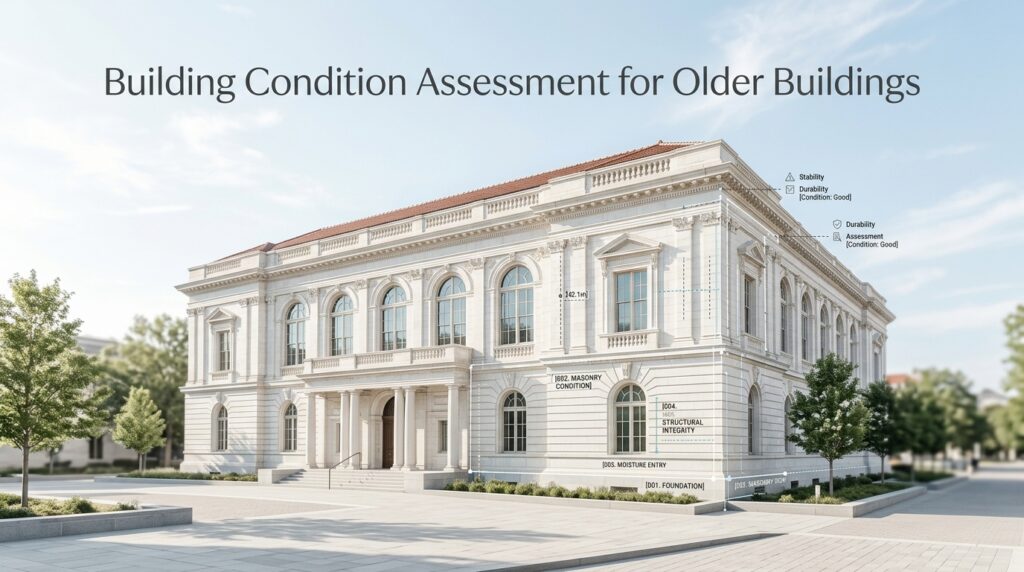
Older buildings can tell you a lot about their history just by looking at them. A crack that appeared years ago, a repaired column, a damp ceiling, an altered floor plan, or an extension added by a previous owner may all be clues about the building’s current condition. The challenge is that not every visible defect represents a serious structural problem, while some important issues may not be obvious during a normal property inspection.
This is where a Building Condition Assessment for older buildings becomes particularly valuable.
A professional assessment provides a structured way to understand the current physical and structural condition of an existing property. It can help identify deterioration, defects, previous modifications, areas requiring further investigation, and repairs or strengthening that may be needed. For owners in Abu Dhabi and Dubai, the need for proper assessment is becoming increasingly important as authorities place greater emphasis on the safety, maintenance, and continued suitability of existing buildings.
Dubai’s Law No. (3) of 2026 Concerning the Quality and Safety of Buildings is particularly relevant to older properties. The law defines a building for its purposes as an existing building completed at least 20 years earlier, or from another date determined by the competent entity where no Completion Certificate exists. It requires applicable buildings to undergo assessment of their structural condition and technical defects for the Quality and Safety Certificate process.
That does not mean every older property automatically requires the same type of Building Condition Assessment. The correct scope depends on the property’s age, construction, history, current condition, planned use, previous modifications, and the reason for the assessment.
Book a consultation with our engineering team
Why Older Buildings Require a Different Assessment Approach
An older building is not necessarily an unsafe building.
Age by itself does not tell an engineer whether a structure is performing properly. A well-maintained 30-year-old building can potentially be in better condition than a poorly maintained 10-year-old building.
What changes with age is the amount of history that needs to be understood.
Older properties may have experienced years of weather exposure, maintenance work, renovations, changes in occupancy, alterations, water infiltration, repairs, or modifications that are not fully documented. Some buildings may also have been designed under standards or practices that differ from those used for newer construction.
That is why an assessment of an older building should look beyond the question of whether something appears damaged today.
The consultant needs to understand how the building has changed over time and whether those changes have affected its current condition.
Current UAE engineering assessment practices for older buildings can include visual inspection, structural evaluation, non-destructive testing, review of available drawings, evaluation of load-bearing elements, and recommendations for repair or strengthening when required.
What Is a Building Condition Assessment for an Older Building?
A Building Condition Assessment is a systematic engineering evaluation of an existing property’s condition.
For an older building, the assessment typically begins with available information about the property and continues with an inspection of accessible areas and relevant building components. Depending on the findings and purpose of the assessment, the engineer may recommend additional testing or structural analysis.
The objective is not simply to create a list of defects.
A useful assessment should help answer practical questions such as:
- What is the current condition of the building?
- Are there visible signs of deterioration?
- Are any defects potentially structural?
- Have previous modifications affected the building?
- Are certain components approaching the end of their useful service life?
- Does the building require repairs or strengthening?
- Is additional testing necessary?
- Can planned renovation work proceed safely?
- Are there authority or certification requirements that need to be addressed?
For older properties, the answers to these questions can influence major financial decisions.
When Should an Older Building Be Assessed?
There is no single age at which every building suddenly becomes unsuitable or requires the same inspection.
However, a condition assessment becomes particularly useful when an older property is showing defects, undergoing renovation, changing ownership, changing use, or being evaluated for safety or compliance purposes.
It may also be appropriate when an owner wants a documented understanding of the property’s condition before investing significant money into it.
For example, an owner purchasing an older villa may want to understand whether visible cracking is cosmetic or requires structural investigation before proceeding with renovation.
Similarly, an investor considering an older commercial property may need to understand whether significant repair or strengthening costs could arise after acquisition.
In Dubai, the current 2026 building-quality law introduces a specific regulatory framework for existing buildings, including buildings that have reached 20 years from their Completion Certificate for the purposes of obtaining a Quality and Safety Certificate.
This makes understanding the condition of older properties increasingly relevant to owners and property managers.
What Does an Assessment Examine in an Older Building?
The exact scope depends on the property and the reason for the assessment.
However, an older-building assessment can examine a combination of structural and physical components.
Structural Elements
Engineers may examine accessible structural elements such as:
- Columns
- Beams
- Slabs
- Structural walls
- Roof structures
- Foundations where accessible or where investigation is required
- Other load-bearing components
The engineer looks for signs of cracking, deterioration, deformation, corrosion, damage, inappropriate modifications, and other conditions that may affect structural performance.
Visible Building Defects
The assessment may also document:
- Cracks
- Concrete spalling
- Exposed reinforcement
- Water damage
- Settlement indicators
- Deteriorated finishes
- Damaged external elements
- Moisture-related deterioration
The important point is that a defect is not automatically a diagnosis.
A crack, for example, may have several possible causes. The engineer needs to assess its characteristics and surrounding conditions before determining whether further investigation is justified.

Cracks in Older Buildings: Should You Be Concerned?
Cracks are one of the most common reasons owners become concerned about an older property.
But cracks need to be interpreted rather than simply counted.
A small crack in a surface finish may have a very different significance from cracking in a structural beam or column. Similarly, the location and pattern of cracking can provide more useful information than the fact that a crack exists.
Engineers may consider:
- Crack location
- Direction and pattern
- Approximate width
- Distribution
- Whether it appears isolated
- Whether it is associated with corrosion
- Whether there are signs of movement
- Whether the crack appears to have changed over time
If you are dealing with an older property where cracking is one of the main concerns, your supporting article Signs Your Building Needs Structural Inspection can provide readers with additional information about situations where a dedicated structural inspection may be appropriate.
The important message for property owners is simple: do not diagnose a structural problem based on a photograph alone.
Concrete Deterioration in Older Buildings
Concrete can deteriorate gradually.
An older building may show signs such as surface cracking, spalling, exposed reinforcement, rust staining, delamination, or localized deterioration.
In reinforced concrete structures, corrosion of reinforcement can become particularly important when moisture and other environmental conditions contribute to deterioration.
During a condition assessment, engineers can document these visible signs and determine whether further investigation is necessary.
In some situations, non-destructive testing may be recommended.
Potential techniques can include rebound hammer testing, ultrasonic testing, reinforcement detection, cover measurements, or other methods depending on the engineering question being investigated. UAE testing laboratories and structural assessment providers currently describe these methods as part of possible structural assessment programs for older buildings.
Testing should not be performed simply because a property is old.
It should be selected because the results can help answer a specific engineering question.
Previous Renovations and Unauthorized Modifications
One of the biggest challenges with older buildings is that the building you see today may not be the building that was originally designed.
Owners may have:
- Removed internal walls
- Added rooms
- Extended balconies
- Changed openings
- Added additional loads
- Modified roofs
- Altered layouts
- Constructed extensions
- Changed the use of spaces
Some of these changes may have been properly designed and approved, while others may not have complete documentation.
This makes previous modifications an important part of an older-building assessment.
The engineer may compare available drawings with the existing condition and identify differences that require further investigation.
For owners dealing with undocumented modifications, this can be particularly important before starting another renovation project.
Comparing Existing Drawings With the Actual Building
Documentation can provide valuable information, but old drawings should not automatically be treated as a perfect representation of the current building.
The property may have changed significantly since the drawings were prepared.
An engineer may therefore compare available documentation with what is physically observed during the site inspection.
This can help identify:
- Layout changes
- Structural modifications
- Extensions
- Altered openings
- Added loads
- Changes to building components
Where significant differences are found, the consultant can determine whether additional investigation or structural analysis is necessary.
This is one of the reasons an assessment can be particularly useful before renovation.
Book a consultation with our engineering team
Water Damage and Moisture in Older Properties
Water is another major issue that should not be ignored in an older building.
Repeated water exposure can contribute to deterioration of finishes, corrosion, concrete damage, and other problems.
During an assessment, engineers may look for:
- Water stains
- Damp areas
- Deteriorated concrete
- Damaged finishes
- Signs of leakage
- Roof-related moisture
- Deterioration around wet areas
The visible symptom may not be located where the actual problem originates.
For example, a ceiling stain inside a villa could be related to a roof, plumbing, waterproofing, or drainage issue.
A professional assessment should therefore consider the wider context rather than simply recording the visible stain.
Assessing the Building Before Renovation
Older buildings are often renovated because owners want to modernize layouts, improve finishes, add rooms, or change the property’s functionality.
But renovation can introduce new loads and modifications to an existing structure.
Before removing walls, creating larger openings, modifying slabs, adding extensions, or making significant structural changes, understanding the existing building is extremely valuable.
A condition assessment can establish a baseline condition before construction begins.
This means that existing cracks and defects can be documented before contractors start work.
For villa owners, you can also direct readers to CBC for Villa Renovation when the renovation project has CBC-related requirements.
The assessment and the renovation design then become connected rather than treated as two completely separate activities.

Building Condition Assessment and CBC
Older-building assessment can sometimes overlap with certification-related requirements, but these concepts should not be treated as identical.
A Building Condition Assessment describes the evaluation of an existing building’s condition.
CBC or other certification processes may involve additional requirements depending on the authority, property, and purpose.
For example, Dubai’s 2026 law establishes a Quality and Safety Certificate process for applicable existing buildings. It requires an Engineering Firm to inspect and assess the building’s structural condition and technical defects, and the technical report must address specified areas including structural integrity, exterior cladding, certain electrical and mechanical installations, windows and doors in specified areas, and relevant safety requirements.
This is why property owners should not assume that a generic condition report automatically satisfies every authority requirement.
If certification is the objective, the assessment should be planned around the applicable regulatory requirements.
For readers researching CBC specifically, your article What is CBC? is the appropriate supporting resource.
How the Assessment Can Help With Long-Term Maintenance
An older building does not necessarily need major renovation simply because it is old.
Sometimes the most valuable outcome of an assessment is knowing what does not require immediate intervention.
A condition assessment can help owners prioritize maintenance.
Instead of treating every defect as equally urgent, recommendations can be organized around the nature and significance of the identified issues.
For example, one issue may require immediate attention while another can be monitored as part of routine maintenance.
This can help property owners allocate budgets more intelligently.
It also provides a documented reference point for future inspections.
If the building is assessed again later, engineers may be able to compare the condition over time and identify whether particular defects are stable or progressing.
When Further Structural Testing May Be Necessary
Visual inspection has limitations.
An engineer may identify a condition that cannot be fully understood simply by looking at it.
For example, visible concrete deterioration may raise questions about the condition of the underlying material or reinforcement.
In such circumstances, additional investigation may be recommended.
Depending on the problem, this could involve:
- Non-destructive testing
- Material testing
- Reinforcement assessment
- Structural calculations
- Load assessment
- Detailed measurements
- Monitoring
- Specialist investigation
The testing strategy should always be linked to the engineering objective.
A professional assessment does not mean performing every possible test on every building.
It means collecting enough reliable information to make a defensible engineering decision.
What Happens When Defects Are Found?
Finding defects does not automatically mean an older building is unsafe.
The next step depends on the type, severity, location, and potential cause of the defect.
Possible recommendations may include:
- Routine maintenance
- Localized repair
- Monitoring
- Further investigation
- Structural repair
- Rehabilitation
- Strengthening
- Replacement of damaged components
- More detailed structural analysis
The important distinction is between identifying a defect and determining its engineering significance.
A good condition assessment should help the property owner understand what needs to happen next rather than simply presenting a long list of problems.
Repair and Strengthening After a Condition Assessment
Sometimes an assessment identifies deterioration that needs to be addressed before the property can continue operating as intended.
Repair may be relatively localized.
Other situations may require structural strengthening or rehabilitation.
For example, an older structure with significant deterioration may require strengthening after the engineer evaluates its existing capacity and the requirements of its intended use.
This is where having engineering capability beyond inspection can be useful.
The same consultancy may be able to move from assessment → analysis → repair design → strengthening supervision, depending on the project scope.
For Story Engineering Consultancy, this connects naturally with the company’s Remedial Work and Strengthening service.
Older Buildings in Dubai: What Property Owners Should Know
Dubai has introduced a significant regulatory development through Law No. (3) of 2026 Concerning the Quality and Safety of Buildings.
The law states that an applicable building is one completed at least 20 years before the date of its Completion Certificate, or from a date determined by the competent entity where no Completion Certificate exists. Owners are required to obtain a Quality and Safety Certificate after 20 years from the Completion Certificate date under the law.
The law also establishes periodic assessment and maintenance objectives, including preserving structural integrity and continued suitability for use.
For buildings subject to the certification process, the assessment is not limited to one visible component. The technical report must address the building’s structural integrity and specified technical areas, and technical testing may be carried out through appropriately licensed and accredited laboratories where required.
The validity period of the Quality and Safety Certificate is also linked to building age: the law specifies 10 years for buildings whose Completion Certificates were issued less than 40 years ago and 5 years for buildings 40 years old or more.
This makes it particularly important for owners of older Dubai properties to distinguish between a general condition assessment and an assessment performed specifically for regulatory certification.
Older Buildings in Abu Dhabi
Older properties in Abu Dhabi can also benefit from professional condition assessment, particularly when owners are dealing with deterioration, renovation, structural concerns, undocumented modifications, or authority-related requirements.
The exact process should be determined based on the property and the purpose of the assessment rather than applying Dubai requirements automatically to Abu Dhabi.
This distinction matters because UAE-wide SEO content should not present one emirate’s regulatory requirements as though they apply identically everywhere.
For property owners in Abu Dhabi, the consultant should establish the relevant authority requirements and define the assessment accordingly.
If the reader is considering a wider engineering project, your article Trusted Engineering Consultancy Abu Dhabi can serve as a supporting internal resource.
Book a consultation with our engineering team
How to Choose an Engineering Consultant for an Older Building
Older buildings can present more uncertainty than new construction.
That makes the consultant’s experience particularly important.
When choosing an engineering consultancy, property owners should look for experience with existing buildings rather than only new-build design.
Useful questions include:
- Does the consultant assess existing structures?
- Can they investigate structural defects?
- Do they have access to appropriate testing capabilities?
- Can they prepare a detailed technical report?
- Can they recommend repairs or strengthening?
- Do they understand the relevant authority requirements?
- Can they support the project if additional engineering work is required?
A consultant who can provide only a basic visual inspection may not be the right choice for a complex older building with structural concerns.
For a practical selection checklist, link readers to How to Choose an Engineering Consultant in Abu Dhabi.
How Much Does a Building Condition Assessment for an Older Building Cost?
There is no universal price for assessing an older building.
The cost can depend on:
- Building size
- Number of floors
- Structural system
- Building age
- Accessibility
- Complexity
- Available drawings
- Number of visible defects
- Required testing
- Required structural analysis
- Reporting requirements
- Authority requirements
A small villa with good documentation and limited visible defects may require a very different scope from a large older commercial building with extensive deterioration.
This is why property owners should request a scope-based quotation.
Comparing two prices without comparing what each assessment includes can be misleading.
One quotation may include only a visual inspection, while another may include detailed documentation, testing, engineering analysis, and a comprehensive technical report.
Building Condition Assessment as a Pre-Purchase Tool
Condition assessment is not only useful after you purchase an older building.
It can also support a property acquisition decision.
Imagine purchasing an older villa because the location and asking price look attractive, only to discover after completion that substantial repairs are required.
A pre-purchase engineering assessment can help identify visible and potentially significant issues before the transaction is finalized.
It cannot eliminate every uncertainty, especially where concealed elements cannot be accessed without destructive investigation.
But it can provide substantially more technical information than relying on a standard property viewing.
For investors and buyers, that information can become part of the overall financial decision.
Why Documentation Matters for Older Buildings
The older the building, the more valuable reliable documentation can become.
Original structural drawings, architectural plans, previous inspection reports, renovation records, repair documents, and authority approvals can help engineers understand the building’s history.
However, documentation should always be compared against the actual building.
A drawing from 20 years ago does not necessarily represent what exists today.
If records are missing, the consultant may need to rely more heavily on site observations, measurements, investigation, and testing.
This is another reason owners should provide every available document before the assessment begins.

Book a consultation with our engineering team
What Should an Older Building Assessment Report Include?
The final report should be useful to the person making decisions about the property.
Depending on the scope, it can include:
- Property information
- Assessment objectives
- Inspection methodology
- Areas inspected
- Observed defects
- Photographic documentation
- Structural observations
- Test results where applicable
- Condition findings
- Engineering interpretation
- Recommended actions
- Additional investigation requirements
- Repair or strengthening recommendations where applicable
For a regulatory assessment, the report may need to follow a specific checklist and submission process.
Dubai’s 2026 law specifically requires the technical report for the Quality and Safety Certificate process to include the items set out in the approved Technical Checklist.
That makes the report more than a collection of photographs. It becomes an engineering document used to support decisions about the building.
Building Condition Assessment vs Structural Inspection
The two services can overlap, but they should not automatically be treated as identical.
A Structural Inspection generally focuses more directly on structural elements and structural concerns.
A Building Condition Assessment can be broader and may consider multiple physical components depending on the project’s purpose.
For example, an older-building assessment might document the structural frame while also considering exterior conditions, water-related deterioration, building envelope issues, and other components included within the agreed scope.
This distinction is important for your website architecture because the dedicated Building Condition Assessment service page should target the broader commercial service intent, while this article focuses specifically on older buildings.
Readers who need a deeper explanation of structural inspection can continue to Signs Your Building Needs Structural Inspection.
When Should You Contact an Engineering Consultant?
You should consider professional assessment when an older property presents conditions that cannot be confidently understood through ordinary observation.
Examples include:
- New or worsening cracks
- Concrete deterioration
- Exposed reinforcement
- Repeated water damage
- Signs of movement
- Previous undocumented alterations
- Planned structural renovation
- Significant changes of use
- Major property acquisition decisions
- Certification or authority requirements
The earlier a potential issue is investigated, the more options the owner may have for managing it.
Waiting until a defect becomes severe can make the eventual repair more disruptive and expensive.
Conclusion
A Building Condition Assessment for older buildings is not simply an inspection designed to find faults.
It is a structured engineering process for understanding how an existing property is performing today, what has changed since its original construction, which defects deserve attention, and what actions may be required next.
For older villas, residential buildings, commercial properties, and other existing structures in Abu Dhabi and Dubai, the assessment can be especially valuable before renovation, property acquisition, major maintenance, structural modification, or certification-related work.
Dubai’s 2026 building-quality legislation also makes the subject increasingly important for owners of older buildings, with a formal framework for assessing applicable existing buildings and obtaining Quality and Safety Certificates.
The key is to avoid treating every old building the same way.
Age is a reason to investigate, not a diagnosis of failure.
A properly scoped assessment gives property owners something far more useful than a simple list of defects: it gives them reliable engineering information they can use to decide whether the building needs monitoring, maintenance, repair, strengthening, further investigation, or no major intervention at all.
Book a consultation with our engineering team
FAQs
How old does a building have to be before it needs a Building Condition Assessment?
There is no universal age threshold for every type of condition assessment. The need depends on the building’s condition, purpose, history, planned works, and applicable authority requirements. In Dubai, Law No. (3) of 2026 establishes a specific framework for applicable existing buildings, including buildings completed at least 20 years earlier for the purposes of the Quality and Safety Certificate process.
Is an old building automatically unsafe?
No. Age alone does not determine structural safety. Maintenance history, construction quality, modifications, environmental exposure, deterioration, and the current condition of structural and building components all matter.
What are the most common problems found in older buildings?
Common findings can include cracking, concrete deterioration, corrosion, water-related damage, settlement indicators, damaged finishes, undocumented modifications, and deterioration of external building components. The significance of each finding needs to be evaluated by a qualified engineer.
Does every older building need destructive testing?
No. Testing is generally recommended when visual inspection and available documentation are not sufficient to answer a specific engineering question. Depending on the circumstances, non-destructive testing or more detailed investigation may be appropriate.
Should I conduct a condition assessment before renovating an old villa?
For significant renovations, especially those involving structural modifications, wall removal, extensions, new openings, or changes that could affect existing loads, a condition assessment can provide valuable information about the existing building before design and construction proceed.